The crime story of Eddie Tipton and how two words exposed a rigged lottery in 2026
· based on the channel Max Crime
Eddie Tipton rigged lottery draws as the information security director of the Multi-State Lottery Association, and the crime story that ended his career turned on a store camera and two ordinary words: "No thanks." He had written the random number generator used to produce winning numbers, and he was not allowed to play the games he helped run. The $16.5 million Hot Lotto ticket that triggered the investigation was bought in Des Moines in December 2010 and sat unclaimed for nearly a year.
What made the Hot Lotto ticket suspicious
The ticket was a winner, and nobody wanted it. A $16.5 million Hot Lotto jackpot bought in Des Moines in December 2010 went unclaimed for close to a year, which is unusual for a prize of that size. Lottery officials grew suspicious when a man called to ask about the claim process and gave a story that did not match what the store recording showed.
With just over an hour left before the claim deadline, a lawyer walked in and turned the ticket over on behalf of an anonymous trust. That maneuver kept the buyer's name out of public records, but it also gave investigators a paper trail of lawyers, trusts and intermediaries to pull apart. The Iowa Division of Criminal Investigation, the Iowa Lottery and the Attorney General's office all had a hand in the case from there.
How the Hot Lotto scheme worked
The scheme depended on inside access to the random number generator, not on luck. Tipton's job gave him control over the software that produced winning numbers for games run through the Multi-State Lottery Association, and prosecutors later established that the code had been altered so certain numbers could be predicted under specific conditions.
- A draw date and game were chosen in advance.
- The altered generator produced a predictable combination on that date.
- A ticket with those numbers was bought at a store in a participating state.
- The prize was claimed through a trust or a lawyer rather than by the buyer directly.
Draw computers were kept off the internet, in a controlled room, which made the tampering harder to spot and harder to prove. The numbers looked random because, to anyone outside the scheme, they were.
The two words that gave Eddie Tipton away
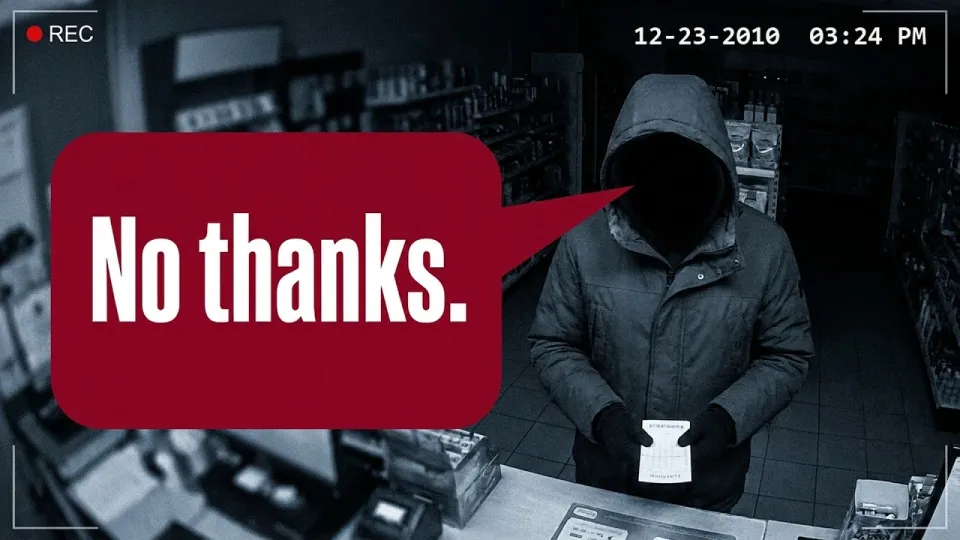
Investigators released the store surveillance video in 2014, and the recording did the work no warrant could. The footage showed a man buying the ticket and being offered a Hot Lotto add-on, to which he replied, "No thanks." Coworkers who saw the video recognized his voice and the way he moved.
The detail mattered because a lottery employee buying a ticket in his own game was already a violation of the rules. The clerk's offer and the flat refusal became the moment the anonymous trust stopped being anonymous. From there, the case moved from a suspicious claim to a named suspect.
Why one second of footage every minute mattered
The draw room camera recorded only about one second out of every minute, which left gaps in the record of who was where. That limitation shaped the investigation: prosecutors could not simply watch the tampering happen on tape.
Instead the case rested on the software, the access logs and the testimony of people who knew the defendant. The computers that generated the numbers were isolated from the internet, so the manipulation had to be done by someone with physical access and the knowledge to use it. That narrowed the field sharply, and the field pointed back to the man who wrote the code.
The trial, the deadline and the guilty plea
The legal fight turned on procedure as much as on evidence. Tipton was tried in Polk County, and the case went up to the Iowa Supreme Court in State v. Tipton, No. 15-1515, over a question about a legal deadline tied to how the charge was filed.
In 2017 Tipton pleaded guilty and admitted manipulating the code used to generate winning numbers. The $16.5 million prize on the Des Moines claim was never paid. The case became the reference point for lottery fraud in the United States, and it changed how multi-state games audit their random number generators and who is allowed near them.
Why the crime story still matters
The lesson is that a rigged draw leaves two kinds of evidence: the code and the people. Auditors can review software, but the scheme collapsed because a man said two words on a store camera and his coworkers knew his voice. Insider fraud in gambling depends on secrecy, and secrecy is exactly what a routine recording destroys.
For anyone following true crime, the Tipton case is a reminder that the most technical scams often end on the most ordinary details — a refusal at a counter, a claim filed an hour before a deadline, a trust set up to hide a name that was never really hidden. Max Crime lays out the full sequence in its video breakdown, from the unclaimed ticket to the confession.
Frequently asked questions about the case
See the FAQ section below for the short answers on who Eddie Tipton was, how the scheme was detected and what happened to the prize money.
Key takeaways
- Eddie Tipton was the information security director at the Multi-State Lottery Association, the body that ran games including Hot Lotto.
- A Hot Lotto ticket bought in Des Moines in December 2010 was worth $16.5 million and went unclaimed for nearly a year.
- Tipton wrote the random number generator code and was barred by his employer from playing the games he helped run.
- Investigators released store CCTV in 2014; coworkers recognized his voice and the way he moved, and he was heard saying "No thanks" to a Hot Lotto add-on.
- Tipton pleaded guilty in 2017 to tampering with lottery equipment, and the $16.5 million claim was never paid.
Source: He Rigged the Lottery. Two Words Gave Him Away. (crime story) · Markdown version
Questions & answers
Who is Eddie Tipton?
Eddie Tipton was the information security director at the Multi-State Lottery Association, the organization that ran games including Hot Lotto. He wrote and maintained the random number generator software used to produce winning numbers, and he was contractually barred from playing those games. He later pleaded guilty to tampering with lottery equipment.
How was the rigged lottery discovered?
A $16.5 million Hot Lotto ticket from Des Moines went unclaimed for nearly a year, and the claim was eventually filed through an anonymous trust by a lawyer with about an hour to spare. When investigators released store surveillance video in 2014, coworkers recognized the buyer's voice and mannerisms, and his "No thanks" to a ticket add-on helped identify him.
Was the $16.5 million jackpot ever paid?
No. The prize on that Hot Lotto claim was never paid out. The investigation into the anonymous trust and the altered random number generator led to charges, a trial in Polk County, an appeal to the Iowa Supreme Court and a 2017 guilty plea.
What happened to Eddie Tipton after he pleaded guilty?
He admitted in 2017 to manipulating the code that generated winning lottery numbers. The conviction made the case a landmark in lottery fraud and prompted tighter controls and audits around random number generators at multi-state lottery organizations.